

Solar EV Charger: How It Works, Cost in India & How Many Panels You Need
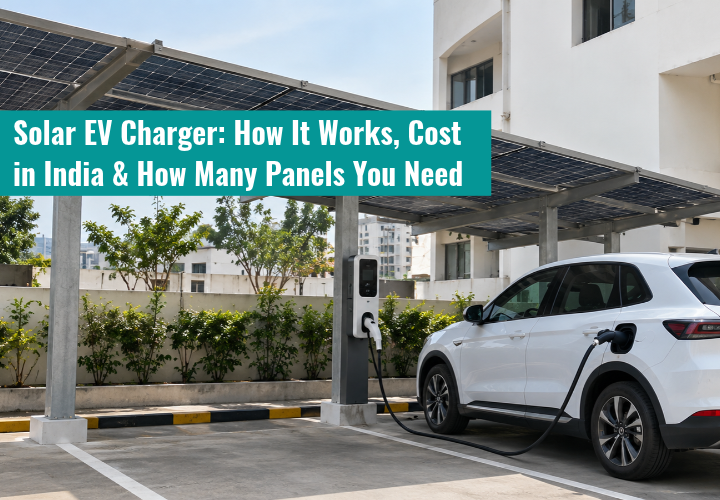
A solar EV charger is a charging setup that powers your electric vehicle with electricity generated by solar panels. Panels produce power, an inverter converts it, and an EV charger delivers it to your car. In India, a home setup needs about 3 to 4 solar panels for a 40 km daily commute and can cut your running cost to a fraction of petrol.
If you drive an EV or plan to buy one, solar EV charging is the most practical way to cut your charging bill and run on cleaner energy. This guide covers how it works, what it costs, how many panels you need, and whether it makes sense for your home or business.
What Is a Solar EV Charger?
A solar EV charger is a solar EV charging system that combines solar panels, an inverter, and an EV charging unit (EVSE). The panels generate electricity from sunlight, and the system uses that power to charge your car’s battery. It can connect to the grid, a battery, or both.
It comes in two broad forms:
- Solar EV charging station for home: a rooftop solar system paired with a 3.3 kW or 7.4 kW AC wall charger (a home-use solar EV car charger).
- Commercial solar EV charging station: a larger solar array, often with a carport or canopy, feeding multiple AC or DC chargers for offices, malls, hotels, housing
How Does a Solar Powered EV Charging Station Work?
A solar powered electric vehicle charging station works in four steps. Panels convert sunlight into DC electricity, an inverter converts it to AC, the power flows through your meter or battery to the EV charger, and the charger safely delivers it to your car. Surplus power goes to the grid or a battery.
- Solar panels capture sunlight and generate DC power.
- Inverter converts DC to AC for home or charger use.
- EV charger (EVSE) manages safe power delivery to the vehicle.
- Grid connection or battery covers nights and cloudy days, and stores or exports extra power.
Can Solar Panels Charge Electric Cars?
Yes, solar panels can charge electric cars. Panels generate electricity, and any EV charger can use it, either directly or through your home’s electrical system. Most setups stay grid-connected, so the car charges even when the sun isn’t shining, while your solar generation offsets the energy used.
Very few systems charge the car directly from panels in real time. In most homes, solar feeds your main supply and the EV charger draws from it. Net metering or a battery handles the day-night gap.
Solar Energy for Electric Cars: Why It Works So Well in India
Solar energy for electric cars works well in India because most regions get 4 to 6 peak sun hours a day. A 1 kW solar system generates about 4 to 5 kWh daily, and an EV uses roughly 0.12 to 0.15 kWh per km, so a small rooftop system can cover daily commuting.
India’s high petrol prices, growing EV adoption, and strong rooftop solar support make solar panels for EV charging one of the best-value upgrades for a home with a car.
How Many Solar Panels Are Needed to Charge an Electric Car?
For a typical Indian daily commute of about 40 km, you need roughly 3 to 4 solar panels (about 1.5 to 2 kW). A 550 W panel produces around 2 to 2.5 kWh per day in India. Your exact number depends on your car’s efficiency, daily distance, and local sunlight
The quick math:
- Average EV consumption: about 0.12 to 0.15 kWh per km
- Daily commute of 40 km: about 5 to 6 kWh per day
- Solar output in India: about 4 to 5 kWh per kW of panels per day
- System losses: add about 15%
| Daily Driving | Energy Needed | Approx. Solar Size | Approx. Panels (550 W) |
|---|---|---|---|
| 20 km | 3 kWh | 0.8 kW | 2 |
| 40 km | 6 kWh | 1.5 to 2 kW | 3 to 4 |
| 60 km | 9 kWh | 2.3 kW | 4 to 5 |
| 100 km | 15 kWh | 4 kW | 7 |
If you also want to cover household usage, size the system for both loads combined. A 3 kW to 5 kW rooftop system is the common choice for homes with an EV.
How Long Does It Take to Charge an EV with Solar?
A 3 kW solar system generates roughly 12 to 15 kWh on a good day, enough to add about 80 to 100 km of range. Fully charging a 30 kWh EV battery from empty takes about two sunny days of generation, or a few hours from a 7.4 kW AC charger drawing from the grid.
The quick math:
- Average EV consumption: about 0.12 to 0.15 kWh per km
- Daily commute of 40 km: about 5 to 6 kWh per day
- Solar output in India: about 4 to 5 kWh per kW of panels per day
- System losses: add about 15%
Charging speed depends on the charger, not the panels. Solar decides how much clean energy you generate, while the charger decides how fast the car fills up.
How to Charge an Electric Car with Solar Panels (Step by Step)
To charge an electric car with solar panels, install a rooftop solar system, connect it through a compatible inverter, add a certified EV charger, and plug in your car. Solar powers your home and charger, with the grid or a battery covering any shortfall.
- Calculate your energy need. Convert your daily distance into kWh.
- Check roof space and shade. You need roughly 8 to 10 sq. m of shadow-free area per kW.
- Choose your system type: on-grid, hybrid, or off-grid.
- Install panels and an inverter through a certified installer.
- Install an EV charger (3.3 kW or 7.4 kW AC for homes).
- Apply for net metering so excess solar power earns you credits.
- Charge smartly. Plug in during the day when solar peaks, or use credits at night.
Types of Solar EV Charging Systems
| Type | Best For | How It Works | Key Limitation |
|---|---|---|---|
| On-grid | Most homes, offices | Solar feeds your supply, grid fills gaps, net metering gives credits | Does not work during grid outages |
| Hybrid | Homes wanting backup | Solar + battery + grid | Higher upfront cost |
| Off-grid | Remote sites | Solar + battery only | Needs bigger battery and more panels |
For most city homes, an on-grid system is the most cost-effective solar EV charging system. Hybrid makes sense if you face frequent power cuts or want to charge at night from stored solar energy.
Solar EV Charging Station Cost in India
A home solar EV charging setup in India typically costs about ₹2.5 lakh to ₹3.5 lakh before subsidy, covering a 3 kW rooftop system and a home EV charger. Commercial solar EV charging stations cost significantly more, depending on solar capacity and the number and type of chargers.
Indicative price ranges (they vary by city, brand, and installer, so always get a current quote):
| Component | Approx. Cost Range |
|---|---|
| 3 kW on-grid rooftop solar | ₹1.8 to ₹2.5 lakh |
| Home AC EV charger (3.3 to 7.4 kW) | ₹15,000 to ₹60,000 |
| Battery backup (optional) | ₹1 to ₹2.5 lakh+ |
| Commercial AC charger (7 to 22 kW) | ₹50,000 to ₹1.5 lakh per unit |
| Commercial DC fast charger (30 kW+) | ₹10 lakh+ per unit |
PM Surya Ghar Subsidy for Solar EV Charging at Home
Under the PM Surya Ghar: Muft Bijli Yojana, homes get ₹30,000 per kW for the first 2 kW and ₹18,000 for the third kW, capped at ₹78,000 for systems of 3 kW or more. The subsidy applies to the rooftop solar system, not the EV charger.
| System Size | Central Subsidy |
|---|---|
| 1 kW | ₹30,000 |
| 2 kW | ₹60,000 |
| 3 kW and above | ₹78,000 (cap) |
So a home setup costing ₹2.5 to ₹3.5 lakh can come down to roughly ₹1.7 to ₹2.7 lakh after the maximum central subsidy. Resident welfare associations and group housing societies can also get ₹18,000 per kW for common facilities, which includes EV charging. Some states add their own subsidy on top. Confirm current rates on the official PM Surya Ghar portal before you apply, since they are revised periodically.
Is a Solar EV Charger Worth It? Cost per km Compared
Yes, for most EV owners it pays off. Grid charging costs roughly ₹1 per km, solar-generated electricity can bring that down to about ₹0.3 to ₹0.5 per km over the system’s life, while petrol costs around ₹6 to ₹8 per km. Rooftop solar typically pays back in 4 to 6 years.
| Fuel Source | Approx. Cost per km |
|---|---|
| Petrol car | ₹6 to ₹8 |
| EV on grid power | ₹0.8 to ₹1.2 |
| EV on rooftop solar | ₹0.3 to ₹0.5 |
Panels last 25 years or more, so after payback you are essentially charging for free for the rest of the system’s life.
Solar Charging Station for Electric Vehicles: Commercial and Public Use
A solar charging station for electric vehicles suits offices, malls, hotels, hospitals, housing societies, and fleet depots. Solar carports generate power and shade parked cars, while AC chargers (7 to 22 kW) suit long parking and DC fast chargers suit quick top-ups.
A solar car charging station also helps businesses attract EV customers, cut daytime electricity bills, and strengthen ESG credentials. A solar powered car charging station is best sized around the site’s daytime load, since solar output peaks between 10 AM and 3 PM.
Benefits of a Solar Electric Vehicle Charger
- Lower running cost: drive for a fraction of grid or petrol cost.
- Cleaner driving: an EV charged by solar has near-zero running emissions.
- Protection from tariff hikes: generate your own power at a fixed cost.
- Net metering income: excess generation earns bill credits.
- Higher property value: solar-ready homes and buildings attract better value.
- Commercial advantage: more footfall and better sustainability credentials.
Things to Check Before Installing
- Roof space and shadow: unshaded, south-facing space gives the best output.
- Sanctioned load and meter type: confirm your DISCOM allows net metering at your size.
- Charger compatibility: match your car’s connector (Type 2 or CCS2) and onboard charger limit.
- Daytime availability: if the car is home only at night, plan for net metering or a battery.
- Installer quality: choose an experienced installer using tier-1 panels and a certified inverter.
Frequently Asked Questions
Can I charge my EV directly from solar panels?
Yes, but most systems route solar power through your home supply and EV charger. True direct charging is uncommon. Grid-connected systems with net metering are simpler and more reliable.
Can a solar EV charger work at night?
Not on solar alone unless you have a battery. On-grid systems draw from the grid at night and offset it with daytime net metering credits.
How many solar panels do I need for an electric car in India?
About 3 to 4 panels (1.5 to 2 kW) for a 40 km daily commute, and about 7 panels (4 kW) for 100 km a day.
What is the cost of a solar EV charging station in India?
A home setup generally costs ₹2.5 lakh to ₹3.5 lakh before subsidy. Commercial stations vary widely based on capacity and charger type.
Is there a subsidy for a solar EV charger in India?
The central PM Surya Ghar scheme gives up to ₹78,000 on a 3 kW or larger rooftop solar system. It covers the solar system, not the EV charger. Some states add extra subsidies.
Is solar EV charging worth it?
Yes. It lowers per-km cost, shields you from tariff hikes, and typically pays back in 4 to 6 years.
Can I install a solar EV charger at home?
Yes, provided you have suitable roof space and your DISCOM permits rooftop solar and net metering. A certified installer handles design and approvals.
What type of charger works with solar?
Any standard AC EV charger works. Smart chargers that prioritise solar surplus add extra savings.
How long does a solar EV charger last?
Panels last 25+ years, inverters 8 to 12 years, and EV chargers around 8 to 10 years with proper maintenance.
Conclusion
A solar EV charger gives you cheaper, cleaner, and more predictable driving. For most Indian homes, a 3 kW rooftop system with a 7.4 kW AC charger covers daily commuting and household use, and the PM Surya Ghar subsidy brings the cost down further. For businesses, a commercial solar EV charging station brings footfall and strengthens the brand. Size the system to your driving, check your roof and DISCOM rules, and get a quote from a certified installer.
Ready to go solar for your EV? Talk to our team for a free site assessment and a customised quote.
Sources: MNRE, PM Surya Ghar Portal, BEE.
Recent Posts
Enquire Now
Recent Posts


On Grid and Off Grid Solar System: Differences, Working & Benefits
October 21, 2026