
Ground Mounted Solar Power Plant in India: Design, Land & Key Considerations
Introduction
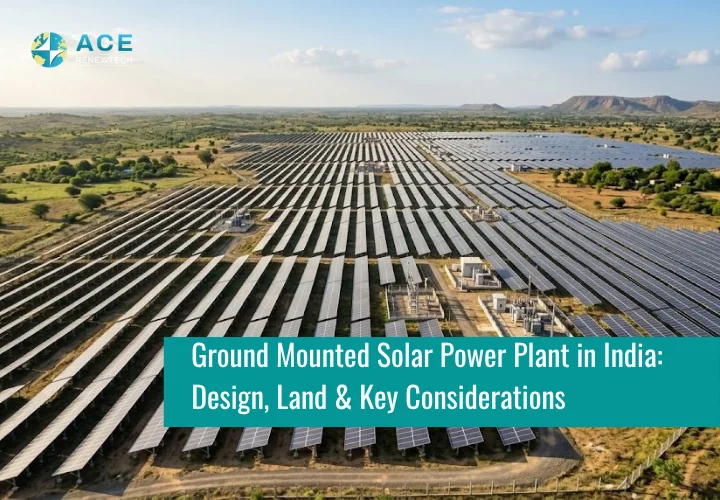
A ground mounted solar power plant in India is a photovoltaic (PV) installation where solar panels are mounted on structures fixed to the ground to generate electricity. These plants are suitable for utility-scale, commercial, industrial, captive, and other large solar applications where adequate land is available. Successful project development depends on site selection, system design, structural engineering, electrical infrastructure, grid connectivity, and long-term operations and maintenance.
What Is a Ground Mounted Solar Power Plant in India?
A ground mounted solar power plant uses PV modules installed on ground-based mounting structures rather than on a building roof. The system can be designed for different capacities depending on land availability, energy requirements, grid connectivity, and project objectives.
In India, ground mounted plants are used for large-scale electricity generation as well as commercial and industrial applications. The final plant configuration depends on the site, technology selected, project capacity, and applicable requirements.
Planning a ground mounted solar project? Early assessment of the site, capacity and technical requirements can help determine the right project approach. ACE Renewtech provides Solar PV utility-scale EPC solutions for organizations evaluating large solar projects.
Why Are Ground Mounted Solar Power Plants Important in India?
Ground mounted solar enables large-capacity renewable electricity generation without depending on building roof space. It also allows greater flexibility in panel layout, orientation, spacing, and maintenance access.
For suitable sites, these systems can support utility-scale power generation, captive consumption, commercial and industrial energy requirements, and broader renewable energy goals.
Land Requirements for a Ground Mounted Solar Plant
Land requirement varies from one project to another rather than following a single fixed acres-per-MW rule. Factors such as plant capacity, module efficiency, mounting technology, row spacing, terrain, internal roads, drainage, equipment areas, and site layout influence the total land requirement.
A proper site assessment should therefore consider not only available land area but also usable land, topography, soil conditions, shading, accessibility, and proximity to grid infrastructure.
How Is a Ground Mounted Solar Project Designed?
The design of a ground mounted solar project generally follows a structured process:
Site assessment → Solar resource analysis → Plant layout → Module selection → String design → Inverter selection → DC/AC design → Transformer and substation planning → Grid connection
The design aims to maximize energy generation while accounting for electrical losses, shading, equipment performance, site conditions, safety, and maintainability.
Considering a new solar project? Working with an experienced EPC partner can help coordinate engineering, equipment selection, construction planning, and project execution from the early stages.
Ground Mounted Solar Structure Design
The ground mounted solar structure design determines how securely PV modules are supported and positioned. The design may include foundations, columns, rails, mounting frames, and module attachment systems.
Structural requirements depend on soil conditions, terrain, wind loads, module configuration, tilt angle, corrosion considerations, and local site conditions. Proper engineering helps maintain structural stability and reliable long-term operation.
Major Components of a Ground Mounted Solar System
A typical ground mounted solar system may include:
- Solar PV modules
- Mounting structures
- DC cables and electrical equipment
- Inverters
- AC collection systems
- Transformers
- Switchgear and protection systems
- Monitoring and SCADA systems
- Substation and grid-evacuation infrastructure
The exact configuration depends on the size and technical requirements of the solar plant.
Installation, Grid Connectivity and Commissioning
Ground mounted solar plant installation typically begins with site preparation and foundation work, followed by mounting structure installation and PV module mounting. DC and AC electrical systems, inverters, transformers, switchgear, monitoring systems, and grid-evacuation infrastructure are then installed and tested.
Grid connectivity requires appropriate technical planning and coordination with the relevant power utility or authority. After installation, testing and commissioning verify that the plant and its electrical systems operate safely and as designed.
Looking for an EPC partner for your solar project? ACE Renewtech provides Solar PV utility-scale EPC solutions, with capabilities covering project execution, O&M, and BESS solutions.
Key Factors Affecting Solar Plant Performance
The performance of a ground mounted solar plant depends on several factors, including solar irradiation, shading, module quality, temperature, soiling, system losses, equipment availability, grid availability, and O&M practices.
Regular monitoring and preventive maintenance can help identify performance issues and support reliable long-term energy generation.
Why Choose an Experienced Solar EPC Partner?
Developing a large solar project involves multiple disciplines, including engineering, procurement, civil construction, electrical installation, commissioning, monitoring, and O&M. An experienced EPC partner can coordinate these activities and align the plant design with site and project requirements.
ACE Renewtech Engineering Private Limited headquartered in Chennai, provides Solar PV utility-scale EPC solutions along with O&M and BESS capabilities. For organizations planning a ground mounted solar power plant in India, ACE Renewtech can support project requirements from engineering and execution through long-term operational considerations.
Frequently Asked Questions (FAQs)
1. How much land is required for a ground mounted solar power plant?
Land requirements depend on plant capacity, module technology, layout, terrain, spacing, roads, drainage, and other site-specific factors. There is no single land requirement applicable to every project.
2. What are the main components of a ground mounted solar plant?
Major components include PV modules, mounting structures, inverters, DC and AC electrical systems, transformers, switchgear, monitoring systems, and grid-evacuation infrastructure.
3. How do I start a ground mounted solar project in India?
Start with site and solar resource assessment, land evaluation, capacity planning, grid-connectivity feasibility, preliminary design, financial evaluation, and selection of an experienced EPC partner.
Recent Posts
Enquire Now
Recent Posts