
Ground Mounted Solar: Definition, Types, Uses & Benefits
Introduction
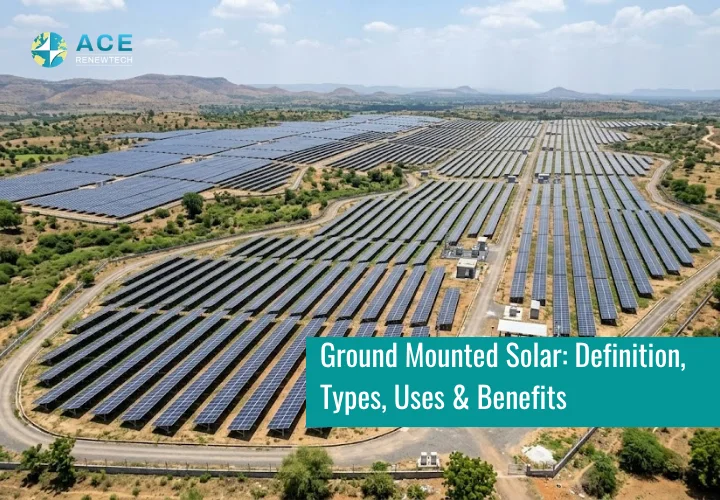
Ground mounted solar is a photovoltaic (PV) installation where solar panels are mounted on structures fixed to the ground rather than on a building roof. It is commonly used for commercial, industrial, agricultural, and utility-scale applications where suitable land is available.
What Is a Ground-Mounted Solar Installation?
A ground-based PV installation uses solar modules supported by engineered structures anchored to the ground. Unlike rooftop systems, it does not depend on the size, orientation, or structural condition of a building roof.
The layout can be planned around available land, solar irradiation, project capacity, terrain, access, and electrical requirements.
How Does a Ground-Mounted System Work?
The basic process is:
Sunlight → PV modules → DC electricity → Inverter → AC electricity → Load or grid
PV modules convert sunlight into direct current (DC). The inverter converts DC power into alternating current (AC). Electricity can then supply connected loads or be exported to the grid. Transformers, cables, switchgear, protection equipment, and monitoring systems support safe operation.
Why Is Ground Mounted Solar Important?
Ground mounted solar enables larger PV installations without depending on rooftop space. It can support renewable electricity generation, reduce dependence on conventional energy sources, and contribute to lower carbon emissions.
Types of Ground-Based Solar Installations
Fixed-Tilt Systems
Fixed-tilt systems keep PV modules at a predetermined angle. Their simple mechanical configuration makes them suitable for many projects.
Single-Axis Tracking Systems
Single-axis trackers move modules along one axis to follow the sun. Depending on site conditions and project economics, tracking can increase energy capture compared with a fixed orientation.
Fixed-Tilt Systems
Dual-axis trackers adjust module position along two axes. They provide more precise tracking but involve greater mechanical complexity.
Solar Mounting Structure
A ground-based solar structure supports PV modules and maintains their required height, tilt, and orientation. Typical elements include foundations, posts, rails, mounting frames, and module attachment components.
Solar structure design should consider soil conditions, terrain, wind loads, module configuration, tilt angle, corrosion protection, drainage, and local site conditions.
What Are the Uses?
Ground mounted solar can be used for:
- Utility-scale solar power plants
- Commercial and industrial facilities
- Solar parks
- Agricultural applications
- Institutional and campus projects
- Remote and off-grid installations
- Community energy projects
A ground-based solar power plant can generate electricity for grid supply, captive consumption, or other project-specific requirements.
What Are the Benefits?
The main benefits of ground mounted solar include:
- Scalability: Suitable for larger generation capacities.
- Flexible positioning: Module orientation and spacing can be planned for the site.
- Maintenance access: Ground-level equipment is generally easier to access.
- Large-project suitability: Appropriate for commercial, industrial, and utility-scale applications.
- Tracking compatibility: Tracking can be used where technically and economically suitable.
- No roof dependency: The system does not rely on an existing building roof.
Ground-Based Solar vs Rooftop Solar
| Factor | Ground-Based Solar | Rooftop Solar |
|---|---|---|
| Location | Open land | Building roof |
| Scalability | Generally higher | Roof-dependent |
| Positioning | More flexible | Roof-dependent |
| Maintenance | Generally easier access | Roof access required |
| Large Projects | Highly suitable | More limited |
Neither option is universally better. The right choice for ground mounted solar depends on available space, required capacity, site conditions, project economics, and energy requirements.
What Should Be Considered Before Installation?
Before developing a solar project, evaluate land availability, solar irradiation, shading, soil conditions, terrain, drainage, accessibility, environmental considerations, and grid connectivity. For a detailed guide covering ground mounted solar power plant in India, including land, design, grid connectivity, and project considerations, explore our dedicated guide.
For larger installations, engineering, civil works, electrical infrastructure, commissioning, monitoring, and long-term O&M should be considered from the planning stage.
Choosing the Right Solar EPC Partner
For ground mounted solar, an experienced EPC partner can coordinate engineering, procurement, civil construction, electrical installation, commissioning, monitoring, and O&M.
ACE Renewtech Engineering Private Limited, headquartered in Chennai, provides Solar PV utility-scale EPC solutions along with O&M and BESS capabilities.
Planning a solar project? Share your site and project requirements with ACE Renewtech to discuss a suitable EPC approach.
Frequently Asked Questions (FAQs)
1. What is a ground-based solar system?
It is a PV system where solar panels are installed on structures fixed to the ground rather than on a building roof.
2. What are the main types?
The main types are fixed-tilt, single-axis tracking, and dual-axis tracking systems.
3. Where is it commonly used?
It is used for utility-scale, commercial, industrial, agricultural, institutional, community, and suitable off-grid applications.
4. Is it better than rooftop solar?
Neither option is universally better. Ground-based systems are generally suitable when sufficient land and larger capacity are required, while rooftop systems use existing building space.
Recent Posts
Enquire Now
Recent Posts