
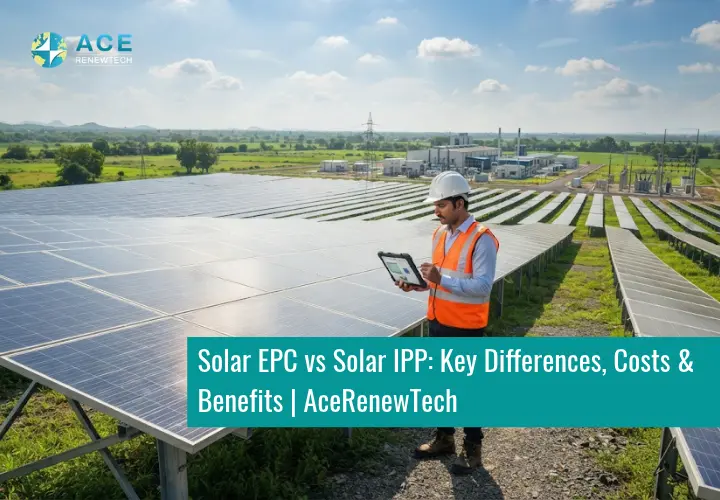
Solar EPC vs Solar IPP: Key Differences, Costs & Benefits | AceRenewTech
Introduction
Choosing the right solar project model is important for businesses planning to reduce electricity expenses and use renewable energy. Two common approaches are Solar EPC (Engineering, Procurement and Construction) and Solar IPP (Independent Power Producer). Both models help businesses access solar power, but they differ in investment, ownership, maintenance and electricity payments.
The main difference between Solar EPC and Solar IPP is ownership In the EPC model, the customer invests in and owns the solar power plant, while an EPC contractor handles its design and construction. In the IPP model, the developer generally invests in, owns and operates the plant and supplies electricity under a Power Purchase Agreement (PPA).
Understanding these differences helps commercial and industrial businesses select the right solar solution based on their budget, electricity consumption and long-term energy requirements.
What Is Solar EPC and How Does It Work?
Solar EPC stands for Engineering, Procurement and Construction. It is a project execution model in which a company takes responsibility for designing, purchasing equipment, constructing and commissioning a solar power plant.
In a typical Solar EPC project, the customer invests in the plant, and the EPC contractor manages the complete installation process.
The main stages of a solar EPC project include:
- Engineering: The project team evaluates the site, electricity requirements, solar potential and system design.
- Procurement: Solar panels, inverters, mounting structures, cables and other equipment are purchased.
- Construction: The solar power plant is installed according to the approved engineering design.
- Commissioning: The completed system is tested and connected for power generation.
- Operation and Maintenance: The plant is monitored and maintained to support consistent performance.
A Solar EPC Company in India helps businesses implement rooftop and ground-mounted solar projects according to their technical and energy requirements.
What Is Solar IPP and How Does the Business Model Work?
Solar IPP stands for Solar Independent Power Producer. It is a business model in which a power developer develops, finances, owns and operates a solar power plant to generate and sell electricity.
Unlike the traditional EPC model, the customer does not necessarily need to purchase or own the solar plant.
A typical Solar IPP project works through the following steps:
- The IPP developer identifies a suitable location and develops the solar project.
- The developer arranges project financing and equipment procurement.
- The solar power plant is constructed and commissioned.
- Electricity is generated and supplied to the buyer under an agreed commercial arrangement.
- The customer pays for the electricity according to the agreed Power Purchase Agreement (PPA).
Solar IPP companies in India may supply electricity through different arrangements, including eligible open-access and group-captive models, depending on applicable regulations and project structure.
This model is particularly relevant for businesses that want to purchase renewable electricity without directly managing the complete solar power plant investment.
How Are Solar EPC and Solar IPP Different?
The main difference between Solar EPC vs Solar IPP is who invests in, owns and operates the solar power plant.
| Comparison Factor | Solar EPC | Solar IPP |
|---|---|---|
| Investment | Customer invests in the project | Developer generally invests |
| Plant Ownership | Customer owns the plant | IPP owns the plant |
| Project Construction | EPC contractor executes construction | IPP arranges project execution |
| Equipment Procurement | Managed by EPC contractor | Managed by IPP |
| Maintenance | Customer or appointed O&M provider | IPP generally handles maintenance |
| Electricity Payment | Customer uses generated electricity | Customer pays an agreed electricity tariff |
| Agreement | EPC contract | Power Purchase Agreement |
| Financial Model | CAPEX | Typically OPEX-based for the buyer |
| Main Benefit | Ownership and long-term savings potential | Lower upfront investment |
Both models offer access to solar energy. However, the right choice depends on the customer's financial position, energy consumption and ownership preference.
Which Is Better: Solar EPC or Solar IPP?
Solar EPC is generally better for businesses that want to own their solar power plant and benefit from its long-term electricity generation. Solar IPP is suitable for businesses that prefer purchasing solar electricity without directly investing in the complete power plant.
Consider these factors before selecting a model.
Solar EPC may be suitable when:
- Your business has sufficient capital or access to project financing.
- You want to own the solar power plant.
- You want greater control over the system and its operation.
- You prefer investing in a long-term energy asset.
- You want to explore applicable depreciation and tax benefits.
Solar IPP may be suitable when:
- You want to avoid a large upfront investment.
- Your business prefers predictable electricity procurement costs.
- You do not want to directly manage solar plant maintenance.
- You can commit to a suitable long-term PPA.
- Your business meets the requirements for the selected power procurement arrangement.
The final decision should be based on a project-specific financial assessment rather than assuming that one model is always cheaper.
What Is the Difference Between CAPEX and OPEX in Solar Projects?
CAPEX and OPEX are two important financial models used in solar power projects. CAPEX involves investing in the solar plant, whereas an OPEX-based arrangement generally allows a customer to purchase electricity without funding the entire plant.
CAPEX Solar Model
Under the CAPEX model, the customer invests in the solar power plant through available funds or project financing.
Key characteristics include:
- Customer owns the solar installation.
- Initial capital investment is required.
- Customer receives the benefits of generated electricity.
- Maintenance can be handled internally or through an O&M contract.
- Applicable asset depreciation benefits may be available.
OPEX Solar Model
Under an OPEX-based solar arrangement, the developer generally invests in and owns the solar power plant. The customer purchases electricity according to the agreed PPA.
Key characteristics include:
- Lower upfront investment for the customer.
- Developer manages plant ownership and operations.
- Electricity is purchased at an agreed tariff.
- Contract terms determine payment obligations.
- Long-term PPA commitments may apply.
The choice betweenCAPEX vs OPEX solar models depends on available capital, electricity tariffs, financing costs and long-term business requirements.
How Does a Solar IPP Project Generate Revenue?
A Solar IPP project generates revenue by selling the electricity produced by its solar power plant to an electricity buyer.
The developer typically earns revenue through an agreed electricity tariff under a Power Purchase Agreement.
The revenue generation process generally includes:
- Developing and financing the solar power plant.
- Generating electricity using solar panels.
- Supplying electricity through an approved power delivery arrangement.
- Billing the buyer according to the agreed PPA terms.
- Managing operating expenses, maintenance and other project costs.
The profitability of a solar IPP project depends on several factors, including project investment, electricity generation, PPA tariff, financing costs, transmission charges and operating expenses.
Can Businesses Combine Solar EPC and Solar IPP Models?
Yes. Businesses can use a combination of solar ownership and renewable electricity procurement models, depending on their energy requirements and applicable regulations.
For example, a manufacturing company may install a rooftop solar power plant through the Solar EPC model to meet part of its daytime electricity consumption. It may also procure additional renewable electricity through an eligible open-access or group-captive arrangement.
This approach can help businesses diversify their electricity sources and manage energy costs.
However, the feasibility of combining these models depends on electricity consumption, project location, grid connectivity, regulatory requirements and commercial agreements.
How Do You Choose the Right Solar Project Model in India?
Selecting between Solar EPC and Solar IPP in India requires evaluating your business's electricity needs and financial objectives.
Consider the following factors:
- Investment Capacity : If your business has sufficient capital or financing options, the EPC model may be suitable. If you prefer to avoid direct plant investment, consider an eligible IPP arrangement.
- Electricity Consumption : Review your monthly electricity bills, peak demand and daily consumption patterns before selecting a solar project model.
- Available Installation : Space Rooftop availability, land requirements and project location influence the choice of solar installation.
- Ownership Preference : Choose EPC if you want to own the solar asset. Consider IPP if you prefer purchasing electricity from a developer-owned plant.
- Long-Term Energy Requirements : Evaluate your future electricity demand, contract duration and expected energy costs before making a decision.
A detailed technical and financial feasibility assessment can help identify the most appropriate solution for your business.
Why Choose AceRenewTech for Solar EPC Solutions?
AceRenewTech is a solar-focused engineering company providing solar EPC and Operation and Maintenance (O&M) services, Established in 2017 and backed by the parent organisation's solar energy experience since 1986, the company supports projects from initial concept through commissioning.
With a team of over 100 engineers and a panel of experts with cumulative experience of more than 200 man-years, AceRenewTech focuses on delivering solar project solutions based on technical requirements and customer energy needs.
Its capabilities include:
- Solar project engineering and design.
- Equipment procurement and project planning.
- Solar power plant construction and installation.
- Project testing and commissioning.
- Solar plant operation and maintenance.
Businesses looking for a reliable Solar EPC Company in India can consider AceRenewTech for engineering-led solar project execution.
Visit AceRenewTech to learn more about its solar EPC solutions and project capabilities.
Frequently Asked Questions About Solar EPC vs Solar IPP
1. What Is the Full Form of IPP in Solar Energy?
IPP stands for Independent Power Producer. It refers to a company or developer that develops, owns or operates power generation facilities and sells the electricity produced to buyers.
2. Is Solar EPC Better Than Solar IPP?
Solar EPC is suitable for businesses that want to invest in and own their solar power plants. Solar IPP is suitable for businesses that prefer purchasing solar electricity without directly funding the entire plant.
3. Do Solar IPP Companies Invest in Solar Power Plants?
Yes. In a typical IPP arrangement, the developer arranges project financing, constructs the plant, retains ownership and manages its operation.
4. What Is an IPP Solar Project?
An IPP solar project is a solar power plant developed and operated by an Independent Power Producer to generate and sell electricity under an agreed commercial arrangement.
5. What Is a Solar Power Purchase Agreement (PPA)?
A Solar Power Purchase Agreement is a contract between an electricity producer and a buyer. It specifies important terms such as electricity tariff, contract duration, power supply conditions and payment responsibilities.
6. What Is the Difference Between CAPEX and OPEX Solar Models?
In a CAPEX model, the customer invests in and owns the solar power plant. In an OPEX-based model, a developer generally owns and operates the plant, while the customer pays for the electricity supplied.
7. Can Industrial Businesses Use Solar IPP Projects in India?
Yes. Eligible industrial and commercial consumers can procure solar electricity through applicable arrangements such as open access and group captive, subject to relevant regulatory and project requirements.
8. Can a Business Switch from Solar IPP to Solar EPC?
A business may transition to plant ownership if the PPA or other project agreements include a suitable purchase or transfer provision. The transition depends on contractual terms, financing arrangements and applicable regulations.
Conclusion
Both Solar EPC and Solar IPPmodels provide businesses with opportunities to adopt renewable energy and manage electricity expenses.
Solar EPC offers plant ownership and greater control over the solar asset, while Solar IPP provides an alternative for businesses that prefer electricity procurement without making the full upfront investment.
Before selecting a model, businesses should evaluate their investment capacity, electricity consumption, project location and long-term energy requirements.
With its solar engineering expertise and end-to-end project execution capabilities, AceRenewTech supports businesses looking to implement reliable solar EPC solutions in India.