
On Grid and Off Grid Solar System: Differences, Working & Benefits
Introduction
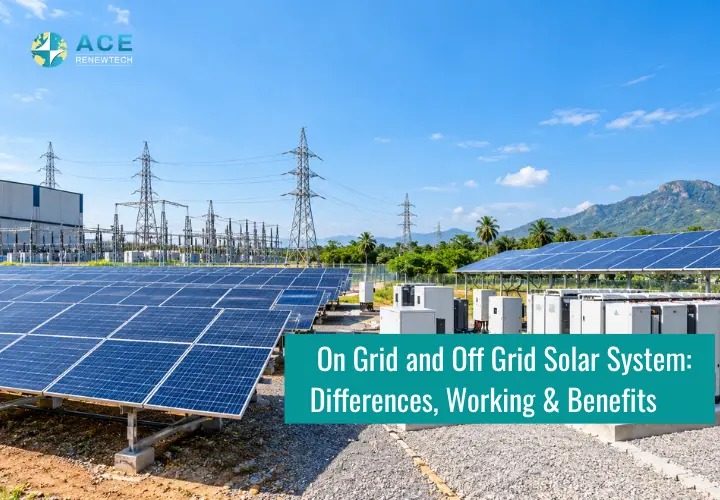
An on grid and off grid solar system differ in grid connectivity, energy storage and backup capability. An on-grid system works alongside the utility grid, while an off-grid system operates independently using suitable battery storage. For businesses and industrial facilities, choosing the right solution depends on electricity demand, grid reliability, operating schedules and backup requirements.
What Is an On-Grid Solar System?
An on grid solar system ,connects a solar photovoltaic (PV) installation to the local electricity grid. Solar panels generate direct current (DC), and a grid-connected inverter converts it into alternating current (AC) for compatible loads. If solar generation is insufficient, the facility draws electricity from the grid. Surplus electricity may be exported where the metering arrangement and local regulations permit.
A typical on grid solar panel installation includes PV modules, an inverter, mounting structures, electrical protection, cables and monitoring equipment.
How Does an On-Grid Solar System Work?
The on grid solar system working principle is straightforward:
- Solar panels generate DC electricity from sunlight.
- The inverter converts DC electricity into AC electricity.
- Solar electricity supplies compatible loads.
- The grid supplies additional electricity when solar generation is insufficient.
These steps explain the working of on grid solar system installations in everyday operation. Standard grid-connected systems usually shut down during a grid outage for safety. Backup requires compatible equipment and a properly designed isolation arrangement.
Components of an On-Grid Solar System
The main components of on grid solar system installations include solar PV modules, a grid-connected inverter, mounting structures, cables, isolators, electrical protection devices, metering and monitoring equipment. These are also commonly described as on grid solar system components. Equipment selection should follow the project's electrical design, site conditions and applicable standards.
What Is an Off-Grid Solar System?
An off-grid solar system generates electricity without relying on a utility grid connection. It is useful for remote locations, isolated facilities and applications where grid access is unavailable or unreliable. Most systems include solar panels, batteries, an inverter and a charge controller where required. Stored energy supplies compatible loads when sunlight is unavailable or solar generation is low.
Difference Between On-Grid and Off-Grid Solar Systems
The difference between on grid and off grid solar system installations mainly involves grid connection, battery storage and backup power.
| Feature | On-Grid Solar | Off-Grid Solar |
|---|---|---|
| Grid connection | Connected to the utility grid | Operates independently |
| Batteries | Not normally required | Generally required |
| During grid outages | Standard systems usually shut down | Can supply loads if stored energy is sufficient |
| Excess generation | May be exported where permitted | Usually stored or used locally |
| Typical use | Grid-connected homes, commercial buildings and industries | Remote or standalone facilities |
People may search for what is on grid and off grid solar system or ask about the difference between ongrid and offgrid solar. In simple terms, the key distinction is whether the system relies on the utility grid or must manage its energy independently.
The comparison is also described as on grid solar system vs off grid, on grid solar vs off grid solar, or off grid solar system vs on grid. Although these phrases express a similar question, the practical decision should consider the site's energy needs and grid conditions. The phrase on grid off grid is sometimes used as shorthand for this comparison.
On-Grid vs Off-Grid: Which Is Suitable?
Choosing off grid and on grid solar power depends on the site's electricity demand and operating conditions. A grid-connected factory with high daytime consumption may be suited to an on-grid system. A remote site without dependable grid access may need an off-grid solution with adequate storage.
When assessing on grid or off grid solar, consider these factors:
- Grid availability: Is the electricity connection dependable?
- Energy consumption: Review electricity bills, operating hours and peak loads.
- Backup requirements: Identify whether essential equipment must operate during outages.
- Installation space: Assess roof or land area, shading and site conditions.
- Electrical integration: Review protection requirements and grid-interconnection rules.
The choice between off grid or on grid solar should follow this site assessment, not just a general preference. For businesses researching what is on grid and off grid solar, the most useful starting point is to compare grid reliability, storage needs and operating priorities.
Benefits and Limitations of On-Grid Solar
The advantages of on grid solar system installations include using solar electricity alongside grid supply and potentially exporting surplus generation where permitted. The on grid solar system benefits depend partly on how closely solar generation matches the facility's demand.
A balanced review of on grid solar system advantages and disadvantages should include solar availability, grid reliability, installation conditions, applicable regulations and whether backup is needed. Standard grid-connected systems generally do not provide power during outages without additional compatible equipment.
Applications in India
A suitable on grid solar system application may include factories, offices, warehouses, educational institutions and other facilities with reliable grid access. Businesses exploring on grid solar system India projects should check site suitability, electrical infrastructure, grid-connection requirements and applicable state regulations.
Some searches use the phrase on grid solar means to ask for a definition: it means a solar installation connected to the utility grid. The term grid in solar system generally refers to the electricity network that a grid-connected solar installation works with.
For commercial and utility-scale projects, engineering assessments should cover the solar resource, roof or land suitability, electrical design, grid evacuation infrastructure, safety and operations and maintenance.
Choosing a Solar EPC Partner
A capable Engineering, Procurement and Construction (EPC) partner coordinates engineering, equipment selection, installation, testing and commissioning. Evaluate relevant project experience, safety procedures, quality control, commissioning and operations and maintenance support.
ACE RenewTech Engineering Private Limited, headquartered in Chennai, Tamil Nadu, provides solar engineering and EPC solutions for utility-scale solar PV projects and Battery Energy Storage Systems (BESS). Businesses can discuss site conditions, electricity demand and project objectives with ACE RenewTech to assess suitable engineering requirements.
Planning a commercial or utility-scale solar project? Contact ACE RenewTech to discuss your project requirements and explore a suitable solar PV solution.
Frequently Asked Questions (FAQs)
1. What is on-grid and off-grid solar?
The question what is on grid and off grid solar system refers to two system configurations: on-grid solar connects to the utility grid, while off-grid solar operates independently and generally uses batteries.
2. How does an on-grid solar system work?
The phrase how does an on grid solar system work refers to panels generating DC electricity, an inverter converting it to AC, and the system supplying compatible loads while the grid provides additional power when needed.
3. Does an on-grid system work during a power cut?
A standard grid-connected system usually shuts down during a grid outage. Backup requires compatible equipment and a properly designed isolation arrangement.
4. Does an off-grid system need batteries?
Most off-grid systems use batteries to store electricity for use at night or when solar generation is low.
5. Which solar system is suitable for industries?
A facility with reliable grid access and substantial daytime electricity consumption may suit an on-grid system. A site requiring independent power may need an off-grid or appropriately designed hybrid solution.
Conclusion
An on-grid system works alongside the utility grid, while an off-grid system operates independently using suitable energy storage. Reviewing electricity demand, grid reliability, backup requirements and site conditions helps identify an appropriate configuration. ACE RenewTech can help businesses assess project requirements and explore solar engineering and EPC solutions.
Recent Posts
Enquire Now
Recent Posts
Ground Mounted Solar: Definition, Types, Uses & Benefits
September 29, 2026