
Key Considerations In Utility-Scale Solar Design & Implementation
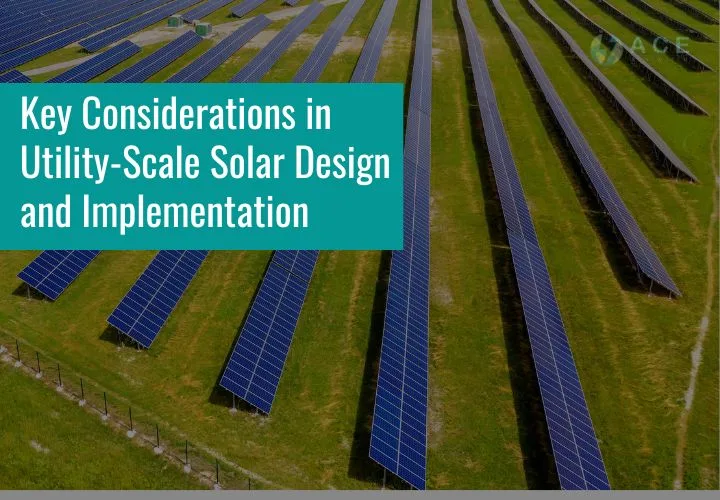
As the world shifts to renewable energy, large-scale solar design for projects is becoming a fundamental pillar for sustainable development. These massive projects require designs for complete power generation systems that feature efficient, clean energy generation and storage capabilities, along with easy distribution options.
Whether you're a policymaker, investor, or EPC professional, this guide walks you through the essential steps to design and implement a high-performing solar power solution.
Navigating the Landscape of Utility-Scale Solar Projects
Utility-scale solar projects are different from smaller residential or commercial setups. They require:
- Large land areas
- Regulatory clearances
- High capital investment
- Strong grid connectivity
The role of EPC companies in such projects has become essential at this point. An EPC company handles project management duties, including procurement, commissioning tasks, and monitoring operational efficiency throughout the project lifecycle.
Optimising Panel Orientation and Tilt for Maximum Efficiency
The proper placement, in terms of direction and solar panel tilt angle, is a key factor that determines their sustained operational capability. A solar array that has the wrong angle can lead to a substantial reduction in the amount of energy produced.
Here’s what experts consider:
- Latitude determines the optimal tilt angle.
- Adjusting the solar panel tilt according to summer and winter sun positions increases the energy production capabilities.
- Tracking systems that operate with single- or dual-axis capabilities enhance energy collection by moving in response to the sun’s movement.
Strategic solar power solutions achieve their maximum efficiency throughout the year by using simulation tools to optimise the orientation.
Strategic Land Use Planning for Solar Installations
The availability of open space alone cannot determine a location’s success, because the right space matters most for an efficient utility scale solar design.
Effective planning involves:
- Soil stability assessments are required to plan the structure before constructing panel structures.
- The project team should operate outside agricultural zones and areas with ecological sensitivity.
- Assessing flooding or erosion risks.
The distance to transmission lines needs to be measured beforehand, as a shorter distance makes it easier to integrate the project into the electric grid.
Seamless Integration with the Power Grid
The actual power generation done is only fifty per cent of the work. The process of delivering solar power to the power grid is the other fifty per cent and requires complex design solutions.
Grid integration includes:
- Interconnection studies
- Substation planning
- Voltage regulation
- Reactive power control
Incorporating Energy Storage Solutions for Reliability
The nature of solar energy ensures that it produces intermittent power output. It is not optional to store energy; it is necessary and mandatory in the future.
Modern utility-scale systems integrate:
- Lithium-ion battery systems
- Flow batteries
- Hybrid solutions with wind or thermal power
Implementing Advanced Monitoring and Control Systems
After deployment, a monitoring system is vital for the continuous operation of the new utility-scale solar design.
Digital platforms track:
- Real-time performance
- Panel temperature
- Inverter efficiency
- Predictive maintenance alerts
SCADA systems (Supervisory Control and Data Acquisition) are a core element of any major solar power setup, thanks to their remote control abilities and fast diagnostic tools, which reduce power outages.
Ensuring Robust Financial Planning and Investment
Utility-scale solar isn’t cheap. When executed correctly, this investment delivers complete value for money.
However, planning for investment must consider:
- CapEx and OpEx breakdowns
- Government subsidies or tax credits
- Return on investment (ROI) timelines
- Power Purchase Agreements (PPAS)
Most prominent EPC companies work with investors and financial institutions to create strategic financing models for guaranteed project profitability for several upcoming decades.
Addressing Environmental and Social Impact Considerations
When implemented with planning, solar power can remain environmentally friendly even in its construction phase, although it has the potential to damage both ecosystems and local communities.
Key impact areas include:
- Biodiversity and land use
- Water management during construction
- Community engagement
- Job creation and local training
FAQ
1.What is utility-scale solar design?
Utility-scale solar design is the process of planning, engineering, and implementing large-scale solar power plants that generate electricity for the utility grid.
2.Why is utility-scale solar design important?
It helps maximize energy generation, improve grid integration, and ensure long-term project performance.
3.What role do EPC companies play in utility-scale solar projects?
EPC companies manage engineering, procurement, construction, commissioning, and project execution for utility-scale solar plants.
4.How much land is required for a utility-scale solar project?
Most utility-scale solar projects require approximately 4–5 acres of land per MW, depending on project requirements and site conditions.
Conclusion
The development process of utility-scale solar projects requires handling both technical and financial, as well as environmental and social, elements. Solar power solutions today extend beyond traditional power generation capabilities due to the expertise provided by EPC companies.
These companies are thus creating long-term value for investors, cleaner air for communities, and a brighter future for the planet.
Recent Posts
Enquire Now
Recent Posts
Ground Mounted Solar: Definition, Types, Uses & Benefits
September 29, 2026