
What Is a Battery Energy Storage System (BESS)? Working, Types & Cost in India
Quick Answer
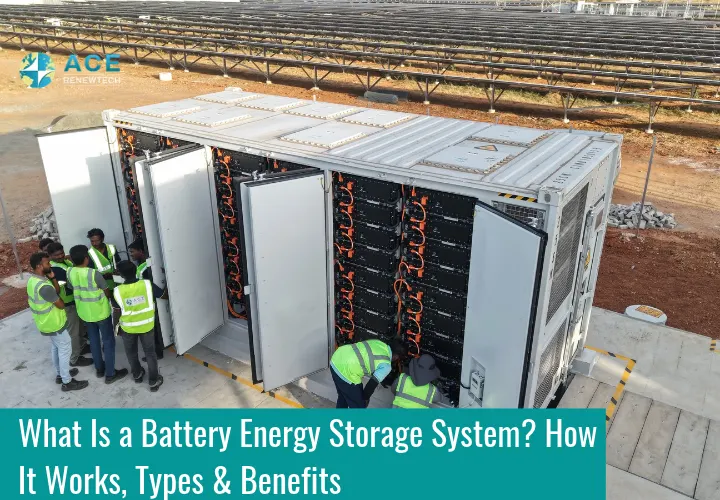
A Battery Energy Storage System (BESS) stores electricity in rechargeable batteries and releases it when needed. A complete BESS system includes battery modules, a Battery Management System (BMS), a Power Conversion System (PCS), an Energy Management System (EMS), thermal management and safety equipment. It is used with solar plants, factories, EV charging and the grid.
Key takeaways
- BESS full form: Battery Energy Storage System.
- A BESS works in three steps: charge, store, discharge.
- LFP is the common battery chemistry for stationary storage in India.
- Cost is quoted per MWh (capex) or per MW per month (tender tariff). Always separate MW (power) from MWh (energy).
- Co-located BESS commissioned by June 30, 2028 gets a 100% ISTS charge waiver under stated conditions (see the India section).
Planning a BESS project? Get a free feasibility check from ACE RenewTech. Contact our team or WhatsApp +91 94873 53335
What Is the Full Form of BESS?
BESS stands for Battery Energy Storage System. If you are searching for the BESS meaning or what BESS stands for in energy projects, it refers to the complete installation (batteries, power electronics, controls and safety systems), not just the battery cells. It is also called an ESS or a battery storage system.
What Is a Battery Energy Storage System?
A Battery Energy Storage System (BESS) stores electricity in rechargeable batteries and supplies it when demand is high or generation is low. It helps manage energy demand and store excess renewable power. It can work with solar plants, commercial and industrial facilities, EV charging infrastructure, microgrids and utility-scale projects. ACE RenewTech offers BESS solutions for solar-integrated and standalone applications.
As renewable generation grows, storage helps manage the gap between when electricity is generated and when it is consumed. Unlike a standalone battery, a BESS includes protection, monitoring and control systems that coordinate safe charging and discharging. The exact configuration depends on whether it serves a facility, a solar plant or a utility-scale project.
How Does a Battery Energy Storage System Work?
A BESS works in three steps. It charges from solar, wind or the grid, stores the energy in battery modules, and discharges it as usable AC power through the PCS when required. The EMS decides when to charge and discharge, and the BMS protects the batteries.
- Charging: Electricity from solar panels, wind generation or the grid enters the system. The PCS manages the conversion required to charge the battery.
- Storing: The batteries hold the energy. The BMS monitors temperature, voltage and state of charge.
- Discharging: The stored energy is released and the PCS converts it to AC for a building, industrial facility or grid.
This is the BESS working principle in short: store energy when it is available or cheap, and release it when it is needed. Performance also depends on round-trip efficiency, usable capacity, power limits and operating conditions. Lithium-ion systems lose some energy in each cycle (round-trip efficiency is often in the mid-to-high 80s percent), so check the OEM datasheet for the exact figure.
What Are the Main Components of a BESS?
The main components of a BESS system are battery modules, a BMS, a PCS, an EMS, thermal management, fire detection and suppression, and switchgear with protection equipment. Together, this BESS technology turns stored chemical energy into grid-ready AC power.
| Component | What it does |
|---|---|
| Battery Modules and Racks | Store the energy, usually lithium-ion (LFP or NMC). |
| Battery Management System (BMS) | Monitors cell voltage, temperature and state of charge, and protects the cells. |
| Power Conversion System (PCS) | Converts DC to AC for the grid or facility, and AC to DC for charging. |
| Energy Management System (EMS) | Decides when to charge and discharge based on tariffs, demand and generation. |
| Thermal Management | Keeps batteries within their safe temperature range. |
| Fire Detection and Suppression | Detects smoke, gas and heat, and suppresses fire. |
| Transformer, Switchgear and Protection | Connect the system safely to the site or grid. |
What Types of Batteries Are Used in BESS?
Lithium-ion is the most widely used battery type in BESS, mainly as LFP (Lithium Iron Phosphate) or NMC (Nickel Manganese Cobalt). Flow batteries, lead-acid and sodium-ion are other options. The BESS battery in most commercial and utility projects in India today is LFP.
- Lithium-ion: High efficiency, fast response, established technology.
- LFP: Good thermal stability and cycle life, suitable for many stationary applications.
- NMC: High energy density, useful where installation space is limited.
- Flow, lead-acid, sodium-ion: Flow suits long-duration storage, lead-acid has a lower upfront cost but a shorter life, and sodium-ion is emerging.
LFP vs NMC: Which Is Better for Energy Storage?
Neither is better in every case. LFP is generally favoured for stationary storage because of its thermal characteristics and cycle life, while NMC suits space-constrained sites that need higher energy density. The right choice depends on the project.
| Comparison Factor | LFP Batteries | NMC Batteries |
|---|---|---|
| Energy Density | Generally lower | Generally higher |
| Thermal Characteristics | Generally favourable | Requires appropriate thermal and safety controls |
| Common Consideration | Cycle life and stationary storage requirements | Higher energy density and space constraints |
| Selection Factors | Safety, usable capacity and lifecycle cost | Energy density, safety and lifecycle cost |
Compare system-level safety, usable capacity, efficiency, warranties, degradation and total lifecycle cost instead of choosing on chemistry alone.
What Are the Benefits of a Battery Energy Storage System?
The main benefits of a BESS are energy shifting, better use of renewable energy, peak demand management, grid support, energy flexibility and backup for critical loads. The actual benefit depends on system design, operating strategy and tariffs
- Energy shifting: Store electricity when it is available and use it later.
- Renewable integration: Improve utilization of solar and wind generation.
- Peak demand management: Supply stored energy during high-demand periods.
- Grid support: Provide services such as frequency response and voltage support.
- Energy flexibility: Give users control over when electricity is consumed.
- Backup capability: Support selected critical loads when designed for it.
What Are the Disadvantages of a BESS?
The main disadvantages of a BESS are high upfront cost, capacity degradation over time, round-trip energy losses, thermal-safety requirements, dependence on imported cells and end-of-life recycling needs. Good design, certified equipment and a proper O&M plan reduce most of these risks.
On imports, landed LFP cell costs in India remain 13 to 23% above China prices (JMK Research, EnergyWatts August 2026). Financial benefits also depend on efficiency, degradation, operating schedules, tariffs, maintenance and installation costs, so run a project assessment before investing.
How Does BESS Support Solar Energy?
A BESS captures surplus solar generation, usually around midday, and releases it later when solar output drops or demand is high. Battery storage for renewable energy improves solar utilization, reduces curtailment and adds flexibility to solar projects. Renewable energy battery storage is now a standard design option for new plants.
For commercial and industrial users, battery storage for solar complements on-site generation and energy management. A solar facility generating more than it consumes can store part of the surplus for later use. The benefit depends on battery capacity, charging opportunities, conversion losses, tariffs and the facility's consumption profile.
If you are still planning the solar plant itself, our solar EPC solutions cover design to commissioning, and our guide to ground-mounted solar explains the most common plant layout. To understand how storage fits with grid connection, see on-grid and off-grid solar systems.
What Are the Applications of a BESS?
BESS is used in commercial and industrial facilities, utility-scale renewable projects, EV charging stations and microgrids.
- Commercial and industrial: Factories, warehouses, hospitals and offices use storage for peak demand management, renewable integration and selected backup.
- Utility-scale: Large renewable projects use grid-scale storage for grid balancing and renewable integration. Read more on utility-scale solar.
- EV charging: Storage supplements grid capacity during high demand where the design supports it.
- Microgrids: Storage balances generation and consumption for industrial sites, campuses, remote locations and critical infrastructure.
What Is the Difference Between Behind-the-Meter and Front-of-the-Meter Storage?
Behind-the-meter (BTM) storage is installed on the consumer side of the meter. Front-of-the-meter (FTM) storage connects on the utility or grid side.
| Comparison Factor | Behind-the-Meter (BTM) | Front-of-the-Meter (FTM) |
|---|---|---|
| Location | Consumer side | Utility or grid side |
| Typical Use | Energy management, solar self-consumption, selected backup | Grid-scale storage and grid services |
The right configuration depends on the facility's energy profile, grid connection, control requirements and operating strategy.
How Much Does a Battery Energy Storage System Cost in India?
BESS cost in India depends on the full configuration, not the battery price alone. As of November 2026, CTUIL's standalone BESS benchmark project cost is ₹0.80 crore per MWh (JMK Research, EnergyWatts October 2026). At that benchmark, a 1 MW / 2 MWh system is about ₹1.6 crore. This is an estimate, not a quotation.
BESS cost reference points (as of November 18, 2026)
| Metric | Reference Point |
|---|---|
| Benchmark Capex | ₹0.80 crore per MWh, CTUIL standalone BESS benchmark (JMK Research) |
| Two-Hour Standalone Tender Tariffs | Roughly ₹2.32 to ₹2.40 lakh per MW per month in 2026 (GreentechLead) |
| Four-Hour Tender Tariff (West Bengal) | ₹4.35 lakh per MW per month (GreentechLead) |
| Stationary Battery Price | $70 to $75 per kWh in 2026, up from $50 to $55 in 2025 (Crisil, via Kalinga TV) |
Compare tariffs on a duration-adjusted basis, since a four-hour project is not directly comparable with a two-hour one.
Cost factors: battery chemistry, power capacity (MW), energy capacity (MWh), storage duration, PCS requirements, thermal management, safety systems, site preparation, electrical infrastructure, and installation and commissioning. A complete assessment should also include warranties, expected degradation, maintenance, replacement or augmentation, and the cost of delivering usable electricity over the system's life.
When comparing quotations, separate power (kW or MW) from energy (kWh or MWh). The ratio of energy to power gives the nominal duration. A 1 MW / 2 MWh system has a nominal two-hour duration, though actual delivery depends on usable capacity, operating limits and efficiency.
Want a project-specific BESS quote? Send us these five details and our team will respond:
- Location and available site area
- Monthly electricity bill or load profile
- Existing or planned solar capacity
- Required backup or peak-shaving duration
- Preferred timeline
Request a BESS quote or WhatsApp +91 94873 53335. You can also email info@acerenewtech.com.
What Is the Demand and Policy Support for BESS in India?
Demand for battery energy storage systems in India is rising as renewable capacity expands. BESS tenders made up almost 40% of all capacity auctioned in fiscal 2026, up from around 5% in each of the two previous years (Crisil, via Kalinga TV). The Central Electricity Authority has estimated that India will need 411.4 GWh of energy storage by 2031-32, including 236.2 GWh of BESS (Energy-Storage.News).
Key policy support (verify the latest Ministry of Power notifications before deciding):
- VGF: A viability gap funding scheme provides ₹5,400 crore for developing 30 GWh of BESS (SolarQuarter). A newer scheme allocates ₹14,500 crore for 92 GWh of energy storage, funded over FY 2026-27 to FY 2030-31 (TaiyangNews).
- ISTS waiver: Co-located BESS projects commissioned on or before June 30, 2028 get a 100% ISTS waiver if the power is consumed outside the state where the BESS is located (PSU Watch).
- Domestic content: BESS projects under the VGF scheme must meet a minimum 20% local content threshold (pv magazine India).
Applications include solar-plus-storage, industrial facilities, commercial buildings, utility-scale projects, EV charging and microgrids. Developers should also assess grid interconnection, electrical safety, site conditions, technical standards and regulatory requirements before selecting and commissioning a system.
How Do You Size a BESS?
Size a BESS by defining the power it must deliver (MW), the energy it must store (MWh) and the duration it must run. Then adjust for usable capacity, efficiency and degradation, because the nameplate capacity is not the energy you can actually deliver.
- Power requirement: The maximum power the system must deliver.
- Energy capacity: How much electricity must be stored.
- Storage duration: How long the system must supply power.
- Battery technology: Efficiency, safety, cycle life and operating conditions.
- Site conditions: Space, temperature and electrical infrastructure.
- Lifecycle economics: Degradation, maintenance and expected operating life
Illustrative example: a facility that wants to shift surplus midday solar to a two-hour evening peak at 1 MW needs a nominal 1 MW / 2 MWh system. Usable capacity and efficiency losses may mean the final design is larger. A detailed engineering assessment confirms the actual size.
How Safe Is a Battery Energy Storage System?
BESS safety depends on system design, not the chemistry alone. Ask suppliers for fire-propagation test reports (such as UL 9540A), battery safety certification (such as IEC 62619), thermal management design, gas and smoke detection, fire suppression, emergency shutdown logic and BMS protection settings. Confirm the Indian standards and grid-code requirements that apply to your project before commissioning.
How Long Does a Battery Energy Storage System Last?
BESS lifespan depends on battery chemistry, operating temperature, depth of discharge, charge and discharge patterns, maintenance and warranty conditions. Battery capacity decreases over time, so review the warranted capacity retention, cycle or throughput limits and any planned augmentation or replacement.
End-of-life planning should also cover safe battery handling, reuse where appropriate and compliant recycling. A structured operations and maintenance plan with remote monitoring helps protect performance over the system's life. For plant-level practices, read our guide to solar power plant operation and maintenance.
How Do You Choose a BESS Supplier or EPC Partner?
Choose a supplier with proven project delivery, certified equipment, clear warranty terms, safety test documentation and an O&M plan. Ask these questions:
- Which projects have you delivered, and at what scale?
- Which certifications and fire-test reports apply to the equipment?
- What capacity retention and cycle limits does the warranty guarantee?
- Who handles O&M, remote monitoring and augmentation?
- Is the quotation priced per MW and MWh with the scope clearly defined?
For a supplier comparison, read our guide to the top battery energy storage system companies in India. If your project is in Tamil Nadu, see our list of EPC companies in Chennai.
Why Choose ACE RenewTech for BESS Projects?
ACE RenewTech Engineering was established in 2017 and is backed by solar experience that began in 1986 with KCP Solar Industry in Southern India (see Our Journey). Headquartered in Chennai, we deliver solar EPC, solar IPP, O&M and storage-integrated projects across India.
- 196.4 MWp of cumulative commissioned solar capacity (milestone reached in 2023)
- Project management for a 450+ MW (DC) solar project in Rajasthan and a 200 MW project in Tirunelveli
- A 110/33 kV, 100 MW solar pooling substation at Kayathar
- O&M with 24/7 remote monitoring
- Acelion Energy Storage Solutions Pvt. Ltd. (established 2022), our sister company for hybrid inverters and BESS solutions
Group Chairman Ashok Kumar P serves as State Advisor for Solar and BESS to the Tamil Nadu Electricity Regulatory Commission (TNERC). He holds a B.E. in Mechanical Engineering and an MS (EDP) from IIT Madras, and has received the National Award from the Solar Energy Society of India (SESI).
Ready to plan your storage project? Talk to ACE RenewTech's experts | Call +91 94873 53335 | WhatsApp us | info@acerenewtech.com
Corporate office: TS-105, SIDCO Industrial Estate, Ekkatuthangal, Chennai 600 032.
Conclusion
A Battery Energy Storage System is a practical way to store electricity and use it when required, supporting solar, industrial facilities, EV charging, microgrids and utility-scale projects. The right solution depends on power, energy capacity, duration, battery technology, site conditions, safety and lifecycle economics. A project-specific engineering assessment should set the final configuration.
Frequently Asked Questions (FAQs)
1. What is a Battery Energy Storage System?
It is a system that stores electricity in rechargeable batteries and supplies it when required, using battery modules, a BMS, PCS, EMS, thermal management and safety equipment.
2. What is the full form of BESS?
BESS stands for Battery Energy Storage System.
3. How does a BESS work?
It charges from solar, wind or the grid, stores the electricity in batteries and releases it as AC power through the PCS when needed.
4. What are the main components of a BESS?
Battery modules, BMS, PCS, EMS, thermal management, fire protection and switchgear.
5. Which battery technology is commonly used in BESS?
Lithium-ion is widely used, and LFP is a common option for stationary energy storage.
6. How much does a BESS cost in India?
CTUIL's standalone BESS benchmark project cost is ₹0.80 crore per MWh. Actual pricing depends on MW, MWh, duration, chemistry and site, so request a project-specific quotation
7. What affects BESS cost?
Battery chemistry, power capacity, energy capacity, storage duration, PCS, safety systems, site requirements and installation all affect total project cost.
8. What is the difference between MW and MWh in a BESS?
MW measures the power a system can deliver, while MWh measures the energy it can store. Both matter when selecting a system.
9. Can battery storage be combined with solar?
Yes. A BESS captures surplus solar generation and supplies it later when solar output is lower or demand is higher.
10. Can a BESS provide backup power during a grid outage?
Yes, if it is designed with suitable backup capability, controls, isolation and protection. Not every grid-connected BESS provides backup automatically.
11. What are the disadvantages of a BESS?
High upfront cost, degradation, round-trip losses, safety requirements, imported cell dependence and recycling needs.
12. Is there government support for BESS in India?
India's VGF scheme provides ₹5,400 crore for 30 GWh of BESS, and co-located BESS commissioned by June 30, 2028 can get a 100% ISTS waiver under stated conditions. Check the latest Ministry of Power notifications.
Recent Posts
Enquire Now
Recent Posts
Solar EPC vs Solar IPP: Key Differences, Costs & Benefits | AceRenewTech
November 19, 2026