
Utility Scale Solar Design & EPC Services in India – AceRenewTech
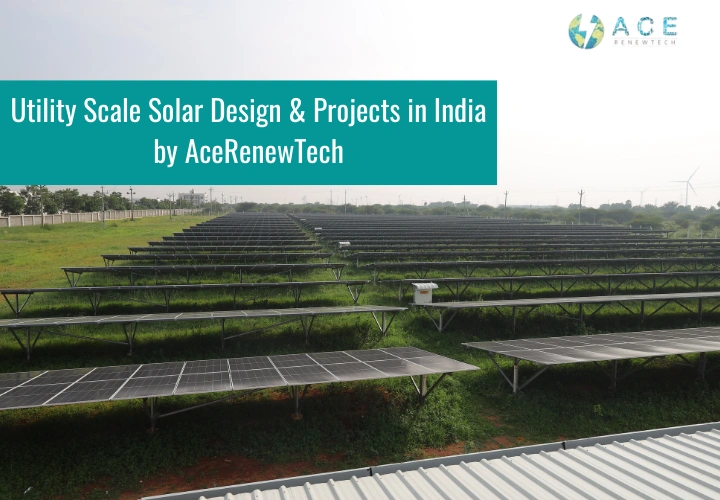
Introduction:Utility Scale Solar Design & Projects in India by AceRenewTech
The use of solar energy has proven to be one of the most effective and sustainable approaches to meeting the rising power requirements of a fast-growing country such as India. As environmental awareness grows and government subsidies are provided, utility-scale solar design has become increasingly relevant nationwide.
This blog explores the specifics of a utility-scale solar project in India, how it is designed and constructed, and the innovations defining the future of solar energy.
Introduction to Utility-Scale Solar Design
Utility-scale solar design involves planning, designing, and installing large-scale solar systems (usually above one megawatt) that feed directly into the power grid.
These projects require careful site selection, extensive electrical distribution, and effective coordination with existing transmission systems. These projects have helped mitigate carbon footprints and provided millions of people with cheap power.
Overview of Large-Scale Solar Projects
India has emerged as a major stakeholder in deploying utility-scale solar projects, with solar parks like Pavagada, Bhadla, and Kurnool setting global standards. The design of large-scale solar facilities involves developing solar farms that may cover hundreds or even thousands of acres.
The increase in these projects has been spurred by government efforts such as the National Solar Mission and state-level renewable energy policies, which involve both government and societal participation.
Key Components of Utility-Scale Solar Design
A well-executed utility-scale solar project integrates multiple essential components that work together to ensure efficient and reliable operation:
Photovoltaic (PV) Modules: Photocells transform the sunlight into electricity efficiently.
- Mounting Structures: The panels should be mounted at right angles to maximise exposure to sunlight.
- Inverters: Convert direct current (DC) to alternating current (AC) so it can be compatible with the grid.
- Cabling and Switchgear:Control the power flow and offer safety measures.
- Monitoring and Control Systems: For remote monitoring and performance analysis.
Steps in Project Planning and Execution
The setup of a large-scale solar plant design includes a series of steps planned thoroughly:
- Feasibility Study: Site analysis, solar irradiation analysis and economic evaluation.
- Design and Engineering: Detailed design of the large-scale solar plant, with electrical and structural design.
- Procurement:The acquisition of high-quality materials, panelling, and elements.
- Construction:Installation of infrastructure, mounting systems and power connections.
- Testing and Commissioning:Before grid integration, it is necessary to ensure that safety and performance standards are met.
Technology and Innovation in Solar Systems
Automation and AI-based monitoring systems can be used to identify issues in real time, whereas site analysis can be conducted more quickly and accurately with drone-based inspections. Bifacial solar modules, intelligent trackers, and energy storage systems also improve efficiency, allowing solar farms to operate even in low-light conditions.
The solar sector in India is still progressing with the integration of smart grids and the use of digital twins, virtual models that simulate solar plant performance and anticipate potential faults to maintain consistent productivity.
AceRenewTech’s Experience in Utility-Scale Solar Design
Our solar team brings years of experience and a proven track record in utility-scale solar design in India. Our engineers blend technical precision with innovative approaches to deliver robust, cost-effective solar solutions—from initial concept through final commissioning.
Our solar plant engineers use the latest simulation tools and software design to make each project productive and efficient.
Common Challenges and Solutions
Although it has enormous potential, the challenges associated with large-scale solar plants are land acquisition, grid connectivity issues and maintenance in remote locations. However, these issues can be successfully solved through proper planning and engineering innovation.
Our teams address these challenges with design optimisation, modular layout, and an intelligent energy management system that is both reliable and maintenance-friendly.
Future Trends and Sustainability
Solar plant engineering in India has a promising future. The country is on track to meet its ambitious solar capacity targets through sustained investment in renewables and a strong focus on sustainability. Innovations like hybrid solar-wind systems, floating solar farms, and grid-scale battery storage are revolutionizing the sector and accelerating India's clean energy transition.
Utility-scale solar plants are also becoming more sustainable through best design practices, efficient solar module recycling, and environmentally friendly construction.
Conclusion
Successful utility-scale solar projects go far beyond installing solar panels. From land assessment and grid integration to financing and long-term monitoring, utility scale solar design requires expertise at every stage.
With its deep technical knowledge and EPC capabilities, AceRenewTech delivers scalable, reliable power solutions that create long-term value for investors, clean energy for communities, and a sustainable future for the planet.
Recent Posts