
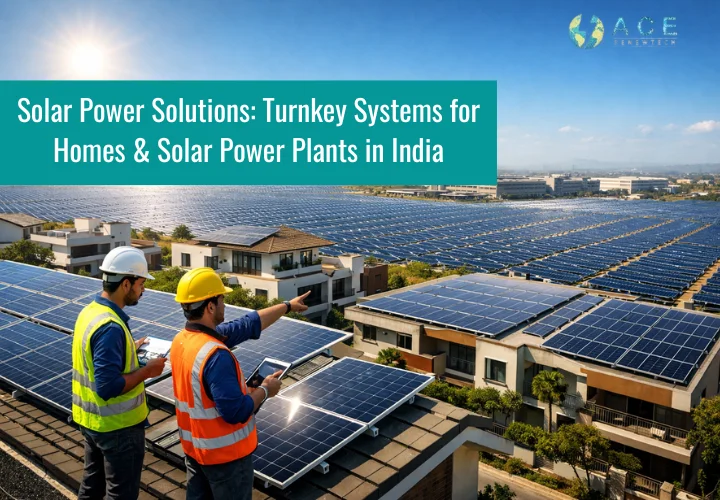
India has rapidly emerged as one of the world’s largest solar energy markets, driven by rising electricity costs, increasing energy demand, and growing awareness of climate change. Today, solar power solutions are widely adopted by homes, businesses, and industries as a reliable primary energy source. From rooftop systems to large-scale projects, solar energy is reshaping how electricity is generated and consumed across the country.
The Growing Demand for Solar Power Solutions in India
The expansion of India’s economy has led to a continuous rise in electricity consumption. With the government targeting 500 GW of non-fossil fuel capacity by 2030, solar energy has become a critical pillar of national energy security.
Frequent grid disruptions, increasing transmission charges, and tariff hikes have further encouraged individuals and organisations to adopt decentralised solar power plant in India models for long-term reliability and cost control.
Solar Power Solutions India: Market Overview and Benefits
Advancements in solar technology, including bifacial panels and high-efficiency cell designs, have significantly improved performance while reducing system costs over the last decade. As a result, solar power solutions India now offer strong financial and operational advantages.
Key benefits include:
-
Energy independence: Generate your own electricity with minimal grid reliance
-
High return on investment: Typical payback periods range from four to six years
-
Environmental impact: Residential systems significantly reduce annual CO₂ emissions
-
Increased property value: Homes with rooftop installations often achieve higher resale value
-
Versatility: Suitable for residential, commercial, and industrial use
Solar Power Solutions for Home: Residential System Options
Choosing the right solar power solutions for home depends on roof availability, energy usage, and local grid conditions. Common residential options include:
-
On-grid systems: Ideal for urban areas with stable grid access and net metering
-
Off-grid systems: Suitable for remote locations, supported by battery storage
-
Hybrid systems: Combine grid connectivity with battery backup for power security
Each configuration uses a tailored solar power system designed to maximise efficiency and reliability for household needs.
Turnkey Solar Power Solutions: End-to-End Execution
Implementing a solar project can be complex, but turnkey solar power solutions simplify the process by assigning complete responsibility to a single provider. This model typically includes:
-
Site survey and feasibility assessment
-
System design and engineering
-
Procurement and installation
-
Statutory approvals and net-metering coordination
By managing all stages under one framework, turnkey execution reduces delays, ensures quality control, and delivers predictable outcomes for both small and large installations.
Solar Power System: Components and Performance
A modern solar power system functions as an integrated energy ecosystem rather than just a panel setup.
Core components include:
-
Solar panels with high conversion efficiency
-
Inverters that convert DC power to usable AC electricity
-
Mounting structures designed for durability
-
Monitoring systems that track real-time performance
When properly designed and installed, these systems deliver consistent power output with minimal maintenance.
Solar Power Plant: Design, Capacity, and Applications
A solar power plant is developed for large-scale electricity generation and is categorised based on capacity and usage:
-
Commercial (10 kW–500 kW): Offices, hospitals, and commercial complexes
-
Industrial (500 kW+): Manufacturing units and warehouses
-
Utility-scale (MW level): Grid-connected power generation
A professionally engineered solar power plant in India ensures long-term performance, regulatory compliance, and stable energy output.
Solar Power Plant in India: Large-Scale Installations
India hosts some of the world’s largest solar installations, demonstrating the viability of large-scale deployment. Projects such as Bhadla Solar Park, Pavagada Solar Park, and Kamuthi Solar Power Project highlight the role of solar in meeting national energy demands.
These developments confirm that a solar power plant in India is not only environmentally sustainable but also economically viable for long-term power generation.
Cost, Subsidy, and ROI of Solar Power Solutions India (2026)
Government initiatives have made solar adoption more accessible. Residential users benefit from subsidies under national schemes, while falling component prices continue to reduce installation costs.
Commercial and industrial projects often achieve strong internal rates of return, making solar one of the most attractive long-term energy investments available today.
Why Solar Power Outperforms Conventional Energy
Unlike fossil-fuel-based electricity, solar power offers predictable costs, minimal maintenance, and long-term sustainability. With no fuel expenses and fewer moving parts, solar systems deliver reliable energy while reducing environmental impact and exposure to tariff fluctuations.
Conclusion: Choosing the Right Solar Partner
Solar energy has become a practical and long-term solution for meeting India’s growing power needs. With proper planning, efficient execution, and consistent support, solar systems can deliver reliable performance and lasting value. AceRenewTech supports customers throughout their solar journey with structured project execution and lifecycle-focused service, enabling a smooth transition to clean and sustainable energy.